Search Medicare Blog
Recent Comments

Understanding the Largest Federal Assistance Program

Social Security is the federal government’s largest single program. Created in 1935, the program now consists of two parts: Old-Age and Survivors Insurance pays benefits to retired workers and to their dependents and survivors.

Disability Insurance (DI) makes payments to disabled workers who are younger than the normal retirement age and to their dependents. In all, about 50 million people now receive Social Security benefits.

During the program’s first four decades, spending for Social Security benefits steadily increased relative to the size of the economy, reaching about 4 percent of gross domestic product in the mid-1970s. That spending was driven largely by repeated expansions of the program.

Since then, spending for Social Security benefits has mostly fluctuated between 4.1 percent and 4.5 percent of GDP. In fiscal year 2007, it accounted for 4.3 percent of GDP.

How Social Security Works

In general, workers are eligible for retirement benefits if they are age 62 or older and have paid sufficient Social Security taxes for at least 10 years. Workers whose employment has been limited because of a physical or mental disability can become eligible for DI benefits at an earlier age and often with a shorter employment history.Various rules for determining eligibility and benefit amounts apply to family members of retired, disabled, or deceased workers.

When retired or disabled workers first claim Social Security benefits, they receive payments based on their average earnings over their working lifetime; those payments are subsequently adjusted to reflect annual changes in the cost of living. The formula used to translate average earnings into benefits is progressive.

In other words, it replaces a larger share of preretirement earnings for people with lower average earnings than it does for people with higher earnings. Both the earnings history and the specific dollar amounts included in the formula are indexed to changes in average annual earnings for the labor force as a whole.

Because average national earnings generally grow faster than the rate of inflation, that indexation causes initial benefits for future recipients to grow in real (inflation-adjusted) terms.

For retirement benefits, a final adjustment is made on the basis of the age at which a recipient chooses to start claiming benefits: The longer a person waits (up to age 70), the higher the benefits will be. That final adjustment is intended to be “actuarially fair,” so that an individual’s total lifetime benefits will be approximately equally valuable regardless of when he or she begins collecting them.
For workers born before 1938, the age of eligibility for full retirement benefits—referred to as Social Security’s normal retirement age—is 65. Under current law, that age is gradually increasing and will be 67 for people born in 1960 or later.

Specifically, the normal retirement age rises by two months per birth year for people born from 1938 through 1943 and again by two months per year for people born from 1955 through 1960. The age at which workers may start receiving reduced benefits—age 62—remains the same.

The Social Security Administration estimates that workers who retire at age 65 in 2008 having had average earnings throughout their career will be eligible for an annual benefit of about $15,000. That amount will replace nearly 40 percent of their preretirement earnings.

In later decades, the replacement rate will be less for workers with average earnings who retire at age 65, mainly because of the scheduled increase in the normal retirement age. Nevertheless, because initial benefits are indexed to average wages, which grow over time, the real value of those benefits will continue to rise.

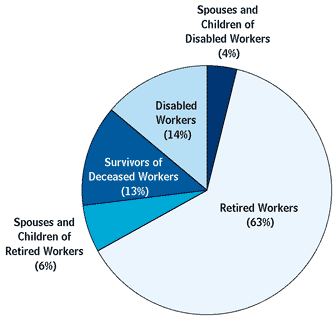
Although Social Security is often characterized as a retirement program, it also provides other benefits. Indeed, only about 63 percent of its beneficiaries receive their payments as retired workers. As of September 2007, 14 percent of beneficiaries were disabled workers, 13 percent were survivors of deceased workers, and the remaining 10 percent were spouses or children of retired or disabled workers.

Source: http://www.cbo.gov/ftpdocs/88xx/doc8877/Chapter3.6.1.shtml

Related posts:

  1. SOCIAL SECURITY BENEFITS PLANNER – www.ssa.gov/planners SOCIAL SECURITY BENEFITS PLANNER - www.ssa.gov/planners...
  2. How do I make sure my social security records are accurate? How do I make sure my records are accurate? Each year your employer sends a copy of your W-2 (Wage and Tax Statement) to Social Security. They compare your name and Social Security number on the W-2 with the information in their files. They add the earnings shown on the W-2 to your Social Security [...]...
  3. Facts About Social Security Facts About Social Security...
  4. Medicare: Social Security Announces 3.6 Percent Benefit Increase for 2012 The Social Security Administration has announced that monthly Social Security and Supplemental Security Income (SSI) benefits will increase 3.6 percent in 2012. The 3.6 percent cost-of-living adjustment (COLA) will begin with the January 2012 benefit payments. Increased payments for people on SSI will begin on December 30, 2011. For some beneficiaries, the increase in their [...]...
  5. New Enhancements to Online Retirement Estimator: Social Security Michael J. Astrue, Commissioner of Social Security, today announced that the online Retirement Estimator, available at www.socialsecurity.gov/estimator, now can provide immediate and personalized benefit estimates to people who have enrolled in Medicare but have not yet filed for Social Security benefits. Previously, these “Medicare only” beneficiaries would need to contact a local office in order to obtain an estimate of their benefits. Currently, about a half-million people file for Medicare each year and delay filing for Social Security benefits....
  6. Learning About Your Social Security Card Number and Information Social Security – Government Assistance A Social Security number is important because you need it to get a job, collect Social Security benefits and receive some other government services. Many other businesses, such as banks and credit companies, also ask for your number. If you are a non-citizen living in the United States, you also [...]...
  7. Social Security E-News Social Security E-News...
  8. Who is Eligible for Medicare Generally, you are eligible for Medicare if you or your spouse worked for at least 10 years in Medicare-covered employment and you are 65 years or older and a citizen or permanent resident of the United States. If you aren’t yet 65, you might also qualify for coverage if you have a disability or with [...]...
  9. How should I protect my Social Security number? How can I protect my Social Security number? You should treat your Social Security number as confidential information and avoid giving it out unnecessarily. You should keep your Social Security card in a safe place with your other important papers. Do not carry it with you unless you need to show it to an employer [...]...
  10. 3 Million Disability Applicants Each Year For Social Security Michael J. Astrue, Commissioner of Social Security, today announced the agency is providing helpful health care information and website links to the more than three million individuals who apply each year for Social Security and Supplemental Security Income (SSI) disability benefits. ...
  11. Social Security Releases Open Government Plan – Medicare Card Information Commissioner of Social Security, today announced that the agency has released its Open Government plan. The plan, available at www.socialsecurity.gov/open, reflects the agency’s commitment to increase transparency, expand opportunities for citizen participation and collaboration, and make open government sustainable at Social Security. ...
  12. Name changed and now I need to tell the Social Security. Where do I start? What if my name changed? If you legally change your name because of marriage, divorce, court order or any other reason, you need to tell Social Security so that you can get a replacement card. If you are working, also tell your employer. If you do not tell them when your name changes, it may: [...]...
  13. MedicareCard.com Finds Social Security Releases Open Government Plan Commissioner of Social Security, today announced that the agency has released its Open Government plan.  The plan, available at www.socialsecurity.gov/open, reflects the agency’s commitment to increase transparency, expand opportunities for citizen participation and collaboration, and make open government sustainable at Social Security.  Three flagship initiatives are highlighted in the plan — the Spanish-Language Retirement Estimator, [...]...
  14. Income of the Aged Population Income of the Aged Population ...
  15. How to Find the Nearest Social Security Office Near You If you live in the United States and you want information and directions to the Social Security office that serves your area, just enter your U.S. Postal Service five-digit ZIP code below and select Locate. You’ll get information about your local Social Security office and other agencies in your area that may be able to [...]...

Leave a Reply

Contact Us | Privacy Statement